
About the Journal
The International Journal of AVGC-XR Design (IJAXD) is an open-access scholarly journal dedicated to advancing research, innovation, and interdisciplinary collaboration across the creative, technological, and design sciences.
IJAXD provides a platform for researchers, academics, educators, artists, designers, technologists, and industry professionals to disseminate original research and contribute to emerging knowledge in Animation, Visual Effects, Gaming, Comics, Design, Extended Reality (XR), Artificial Intelligence (AI), and related fields.
The journal welcomes original research articles, review papers, theoretical and conceptual studies, technical papers, case studies, and practice-based research that demonstrate academic rigour, originality, and relevance to its aims and scope.
By encouraging collaboration across art, design, computing, science, and technology, IJAXD seeks to promote scholarly exchange and contribute to the development of creative practices, immersive experiences, and emerging digital technologies.
IJAXD aims to maintain transparent editorial practices, responsible research standards, and broad accessibility to scholarly knowledge.
Focus and Scope
The International Journal of AVGC-XR Design (IJAXD) is an international, peer-reviewed, open-access scholarly journal dedicated to advancing research, innovation, critical inquiry, and interdisciplinary collaboration across Animation, Visual Effects, Gaming, Comics, Design, Artificial Intelligence, Extended Reality (XR), and associated creative and digital technologies.
The journal explores the intersection of creative practice, design research, scientific inquiry, technological innovation, and human experience. It provides a scholarly platform for original research articles, review papers, theoretical and conceptual studies, technical contributions, case studies, and practice-based research that advance knowledge, methodologies, applications, and critical understanding within the AVGC-XR and design ecosystem.
IJAXD recognises that contemporary creative and design practices increasingly intersect with computing, engineering, cognitive science, humanities, social sciences, education, business, and other academic disciplines. Accordingly, the journal welcomes interdisciplinary research that establishes a meaningful connection with animation, visual effects, gaming, comics, visual communication, design disciplines, immersive technologies, digital media, or creative and human-centred applications of emerging technologies.
The journal considers research in, but not limited to, the following areas:
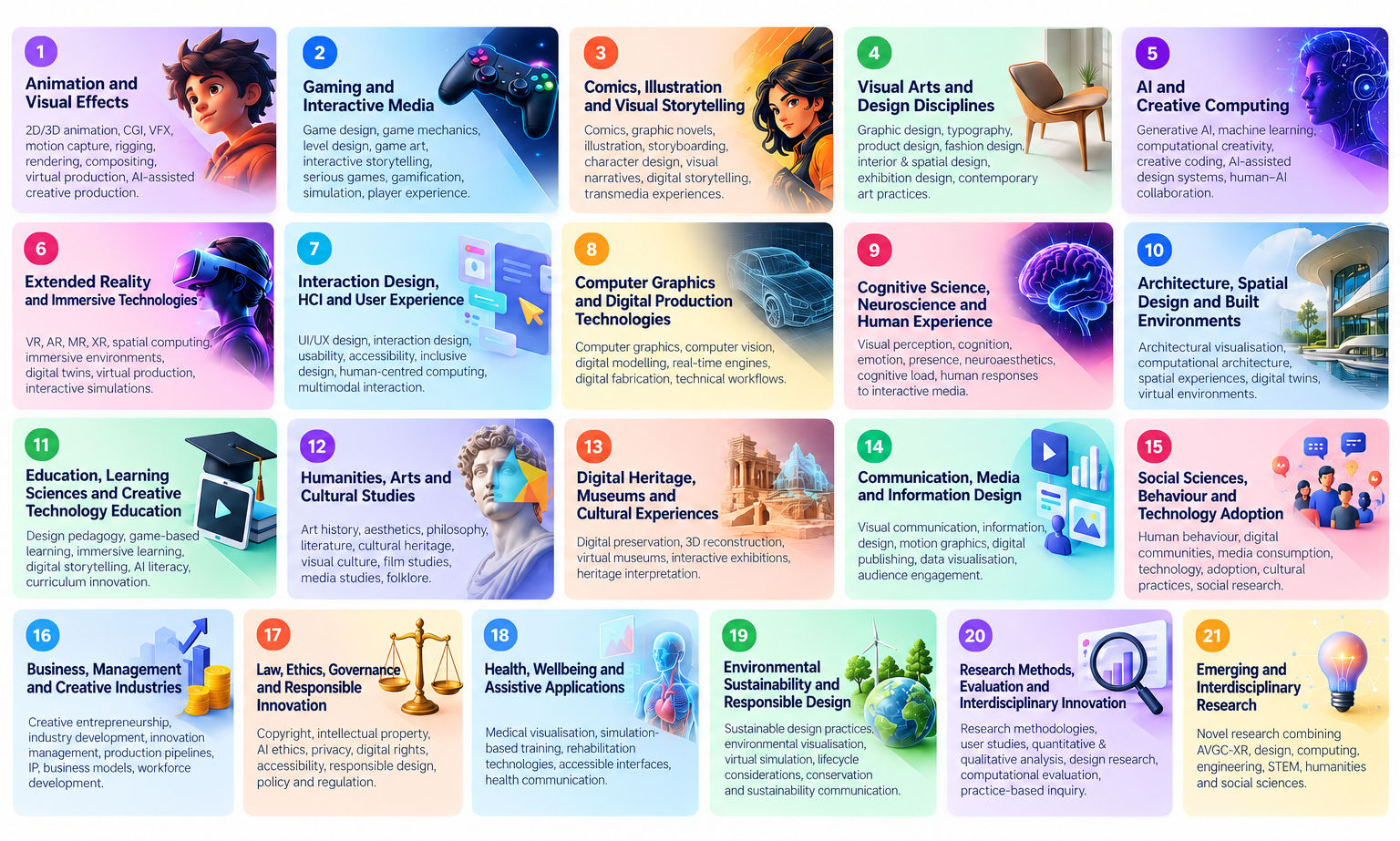 IJAXD encourages theoretical, empirical, experimental, computational, critical, design-led, and practice-based approaches. Both discipline-specific and interdisciplinary submissions are welcome when they demonstrate academic rigour, appropriate research methods, a clear scholarly contribution, and a meaningful connection to the journal's focus.
The journal aims to foster collaboration among researchers, designers, artists, animators, game developers, technologists, educators, scientists, and practitioners, contributing to the advancement of knowledge and responsible innovation across the AVGC-XR and design ecosystem.
Scope and editorial relevance: Inclusion within a listed area does not automatically guarantee acceptance. All submissions must demonstrate a clear relationship to AVGC-XR, design, creative technologies, digital media, visual communication, or associated human-centered applications. Manuscripts undergo editorial screening and the journal's established peer-review process in accordance with its published policies.
Peer Review process
IJAXD uses a double-blind peer-review model, in which authors and reviewers are not informed of each other's identities during the review process. The purpose of peer review is to assess the originality, relevance, methodological quality, clarity, and scholarly contribution of submitted manuscripts.
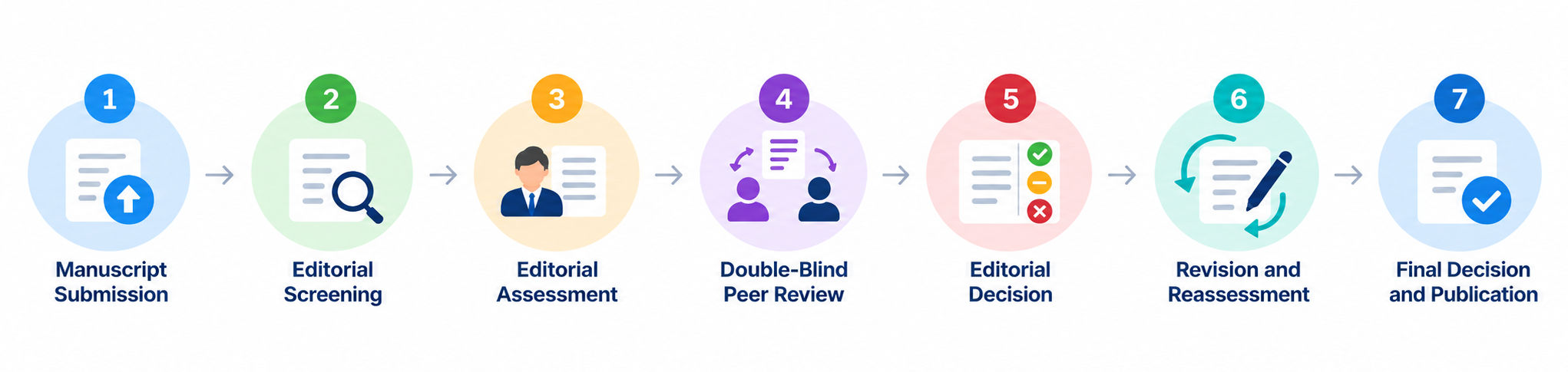
Double-Blind Submission Requirements
To support anonymous review, authors should submit the following as separate files:
-
Title Page: Manuscript title, author names, institutional affiliations, corresponding author's contact details, acknowledgements, and declarations required by the journal.
-
Blinded Manuscript: The main text, abstract, references, tables, figures, and other relevant content, with author-identifying information removed where feasible.
Authors should also ensure that identifying information is removed from document properties and that references to their own work do not unnecessarily reveal their identities.
Editorial Independence and Confidentiality
Reviewers are expected to treat manuscripts as confidential and to disclose potential conflicts of interest. Editorial decisions should be based on scholarly merit, relevance, research integrity, and the evidence presented rather than the authors' personal characteristics or institutional affiliations.
The journal aims to conduct peer review fairly and consistently. Review timelines may vary depending on reviewer availability, manuscript complexity, and the need for revisions.
Ethical Guidelines and COPE Principles
The International Journal of AVGC-XR Design (IJAXD) recognises the importance of ethical, fair, and transparent peer review in scholarly publishing. The journal draws on the ethical principles and guidance published by the Committee on Publication Ethics (COPE), including the COPE Ethical Guidelines for Peer Reviewers.
Reviewers are expected to conduct assessments objectively, maintain manuscript confidentiality, disclose conflicts of interest, provide constructive and evidence-based feedback, and alert the editor to potential concerns involving plagiarism, research misconduct, or ethical non-compliance.
Reviewers should not use unpublished information for personal advantage or share manuscript content with third parties without editorial permission. Any concerns regarding research integrity should be communicated confidentially to the editor.
These principles support IJAXD's commitment to responsible editorial decision-making, research integrity, and a fair peer-review process. Reference to COPE guidance does not, by itself, imply that IJAXD is a COPE member or has obtained any formal endorsement from the organisation.
Artificial Intelligence (AI) Policy
The International Journal of AVGC-XR Design (IJAXD) recognises the growing role of artificial intelligence (AI), generative AI, and AI-assisted technologies in research, academic writing, design, animation, visual effects, gaming, and digital media production.
IJAXD supports the responsible and transparent use of AI while maintaining standards of research integrity, originality, accountability, confidentiality, and ethical scholarly publishing. This policy applies to authors, reviewers, editors, and other contributors involved in the journal's publication process.
The policy draws on relevant guidance from the Committee on Publication Ethics (COPE), including its position on AI authorship, and the recommendations of the International Committee of Medical Journal Editors (ICMJE) concerning AI-assisted technologies.
Use of AI by Authors
Authors may use AI-assisted tools for appropriate research and writing activities, provided that their use does not compromise the accuracy, originality, integrity, or ethical standards of the submitted work.
Examples include language editing, grammar correction, translation assistance, literature organisation, coding support, data analysis, visualisation, and the development of creative or computational artefacts.
Authors remain fully responsible for all content submitted to IJAXD, including material generated or modified using AI tools.
Authors must:
-
Verify the accuracy, relevance, and reliability of AI-generated information.
-
Ensure that citations, references, quotations, and factual claims are authentic and correctly attributed.
-
Review AI-generated content for errors, bias, fabricated references, plagiarism, and misleading interpretations.
-
Ensure that the use of AI does not violate copyright, licensing terms, privacy rights, confidentiality, or research ethics.
-
Disclose substantive AI assistance in accordance with this policy.
Routine spelling, grammar correction, and basic language editing that do not materially contribute to the intellectual content of a manuscript generally do not require a separate declaration. When AI substantially contributes to the content, analysis, or presentation of research, disclosure is required.
Disclosure of AI Use
Authors must disclose material use of AI-assisted technologies in preparing a manuscript or producing its research outputs.
The disclosure should identify:
-
The name of the AI tool or system and, where relevant, its version.
-
The purpose for which the tool was used.
-
The parts of the research or manuscript affected by its use.
-
The extent of human verification, validation, or modification, where relevant.
The disclosure should be included in an appropriately titled section, such as “Declaration of AI-Assisted Technologies” or “AI Use Disclosure.” Where AI is used as part of the research methodology, its use should also be described in the relevant Methods section.
Authors should provide the disclosure at submission and update it if material AI use changes during revision.
AI-Generated Images, Animation, Visual Effects, and Digital Assets
Given the journal's focus on AVGC-XR and design, authors must exercise particular care when using AI to generate or modify visual and multimedia content.
This includes AI-generated illustrations, photographs, diagrams, graphical abstracts, animation sequences, visual effects, textures, 3D models, synthetic environments, and other digital assets presented as part of a manuscript.
Authors must:
-
Disclose material AI generation or modification of figures, images, animations, and other research outputs.
-
Describe the tools and relevant methods used when necessary to understand or reproduce the work.
-
Ensure that generated or modified visuals do not misrepresent research findings, experimental evidence, or real-world events.
-
Verify that the use of source material complies with applicable copyright, licensing, consent, and attribution requirements.
-
Identify synthetic or AI-generated data and visualisations where their nature could affect the interpretation of the research.
AI-generated visuals must not be presented as authentic photographs, original experimental observations, or unaltered documentary evidence when they are not. Any image manipulation must be consistent with the requirements of the relevant research method and must not mislead readers.
Authors must not use AI to fabricate research evidence, manipulate results deceptively, or create misleading representations of people, events, objects, or research outcomes.
AI in Research Methods, Data, and Analysis
When AI tools are used in data collection, processing, analysis, modelling, coding, simulation, or the generation of synthetic datasets, authors must describe their use in the Methods section or another appropriate section.
Where relevant, authors should identify the tool or model, its version, the principal parameters or procedures, the nature of the input data, and the validation methods used.
Authors must verify the suitability and reliability of AI-assisted results and acknowledge relevant methodological limitations, biases, and uncertainty.
AI-generated or AI-assisted analysis must not replace the responsibility of researchers to interpret results critically and substantiate their conclusions with appropriate evidence.
AI Authorship and Accountability
AI systems, chatbots, and other AI-assisted technologies cannot be listed as authors or co-authors of manuscripts submitted to IJAXD.
Authorship must be attributed to eligible human contributors who can take responsibility for the work and meet the applicable authorship criteria.
Authors are accountable for the originality, accuracy, integrity, and ethical compliance of the entire manuscript, including content produced with AI assistance. AI tools must not be credited as authors in the reference list.
Use of AI by Reviewers
Peer reviewers must protect the confidentiality of submitted manuscripts, unpublished research, reviewer reports, and editorial communications.
Reviewers must not upload manuscripts, substantial excerpts, figures, supplementary files, or confidential review materials to external AI systems where confidentiality and appropriate data protection cannot be assured.
Reviewers must obtain prior editorial permission before using AI tools to assist with manuscript evaluation or preparation of reviewer reports. Such use may be permitted only where confidentiality can be adequately protected and the journal's requirements are satisfied.
AI tools must not replace a reviewer's independent scholarly judgement. Reviewers remain responsible for the accuracy, fairness, relevance, and quality of their assessments and must disclose permitted material use of AI to the editor.
Use of AI by Editors
Editors must maintain the confidentiality of submissions and exercise independent editorial judgement.
Editors must not upload confidential manuscripts or review materials to external AI systems where confidentiality cannot be assured, unless the authors have explicitly permitted the relevant use and appropriate safeguards are in place.
AI tools may assist with appropriate administrative or editorial tasks where permitted, but must not independently determine acceptance, rejection, or other substantive editorial outcomes. Editors remain responsible for editorial decisions, ethical oversight, and the accuracy of communications issued under the journal's authority.
Any material use of AI in editorial processes must be transparent to the extent appropriate and consistent with confidentiality obligations
Plagiarism, Research Misconduct, and AI Detection
AI-assisted content is subject to the same standards of originality, proper attribution, research integrity, and ethical conduct as all other submitted material.
Undisclosed or inappropriate AI use, fabricated references, misrepresented research outputs, copyright violations, or deceptive manipulation of data or images may lead to editorial investigation and appropriate action under the journal's applicable policies.
AI-detection tools may produce false positives and false negatives. An AI-detection score alone must not be treated as conclusive evidence of misconduct or serve as the sole basis for rejecting a manuscript. Any concerns should be assessed in context, with appropriate editorial judgement and an opportunity for the authors to respond.
Policy Compliance and Editorial Action
IJAXD may request clarification, supporting information, or relevant disclosures when questions arise concerning the use of AI in a submission.
Where a potential breach is identified, the journal will assess the matter in accordance with its applicable editorial and publication ethics procedures. Depending on the circumstances and the findings, possible actions may include requesting corrections or additional disclosures, returning a manuscript for revision, rejecting a submission, or taking appropriate post-publication action.
Any action will be proportionate to the nature and seriousness of the concern and consistent with applicable publication ethics principles.
Alignment with Publication Ethics Guidance
This policy draws on the following guidance:
-
Committee on Publication Ethics (COPE): Authorship and AI Tools.
-
International Committee of Medical Journal Editors (ICMJE): Recommendations on the Use of Artificial Intelligence in Publishing.
IJAXD may review and update this policy as AI technologies, research practices, applicable legal requirements, and scholarly publishing standards evolve.
Reference to COPE and ICMJE guidance does not imply formal membership, certification, or endorsement by either organisation.